.png)
How to abort the mission: when your brain pulls the ejection handle at 1 a.m.
Ugh, I did everything right.
My sleep the night before was solid. I hit my exercise goals. My nutrition was on point. I spent my day in meaningful work and had lots of deep connections with my tribe—providing much-needed support to our family. By all accounts, I was on a perfect "summit push."
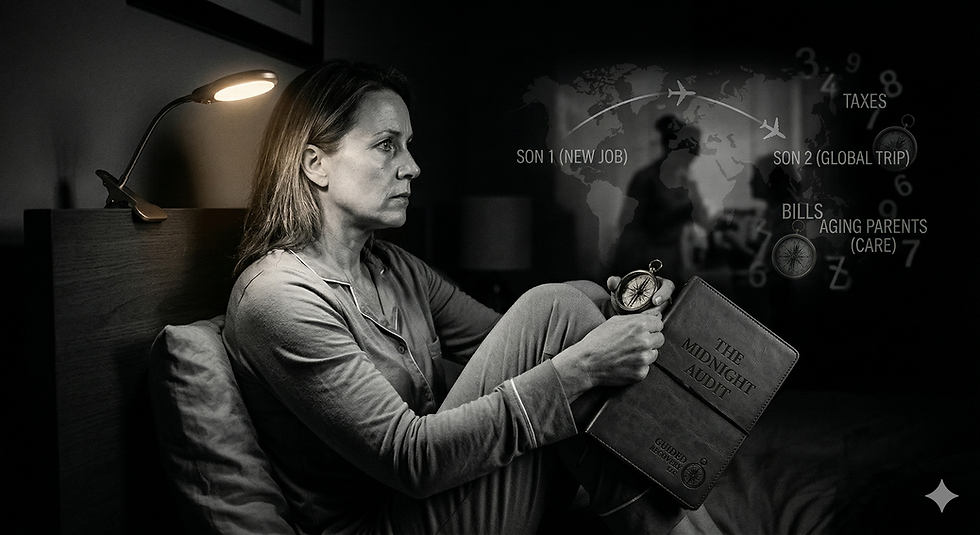
But three hours into my sleep last night, the cabin pressure dropped. I woke up in a complete stress panic, my mind racing through a checklist of bills, taxes, aging parents, and my sons—one moving to a new city, the other heading halfway around the world.
For over two hours, I was caught in a "biological stall." When I finally woke up this morning, my sleep score was 57—a metric I haven't seen since the days when alcohol was a part of my life.
My husband looked at me this morning and said, "what could possibly be wrong?" The answer isn't that I’m failing my recovery; it’s that my brain is finally healthy enough to perform a Midnight Audit.
The Neuroscience of the "3:00 AM Surge"
When I used to drink, I didn't actually "sleep"—I sedated. I bypassed the brain's natural processing phases. In recovery, our nervous system is a high-fidelity instrument. But that means it also picks up the "low-frequency hum" of life’s heavy lifting.
The Cortisol Cross-Fade: Around 3:00 AM, our body naturally begins a slight uptick in cortisol (the stress hormone) to prepare us for waking (for me that happened at midnight last night because I went to bed exhausted at 8 pm). For a finely-tuned nervous system, if there is a massive amount of "unprocessed data" (like finances or the safety of our children), that tiny natural surge can act like a match in a room full of gasoline. The amygdala—our brain’s smoke detector—mistakes this natural hormone shift for a 4-alarm fire.
The "Default Mode Network" (DMN): When we are asleep or resting, the DMN is active. This is the part of the brain responsible for "self-referential" thoughts—our past, our future, and our worries. Without the chemical "mute button" of things like alcohol, marijuana or sleeping pills, the DMN can sometimes go into overdrive, "scouting" for every possible threat to our tribe to ensure we’re prepared for the trek ahead.
The Raw Fidelity of the "Edge"
For those in our orbit who haven't struggled with substance use (or don't realize they are struggling), the concept of "taking the edge off" is often a casual, low-stakes choice. But in sobriety, the "edge" isn't just a metaphor—it is a literal, jagged sensory experience. When we removed mind-altering substances, we removed the artificial shock absorbers that once softened the impact of life's heavy lifting. We no longer have a chemical "dimmer switch" for our anxiety or a "mute button" for our worries. We have to feel every bump on the trail in high definition.
This means that when a "3:00 AM Surge" hits, we don't have a shortcut to calm our nervous system. We have to rely entirely on Self-Regulation—the manual, sometimes exhausting work of breathing, meditating, grounding, and staying present through the storm. To an outsider, it might look like we are overreacting to a "typical" worry, but what they are seeing is a human being navigating a high-speed descent without any brakes. We aren't being "dramatic"; we are being authentic, and learning to regulate that raw energy is a "summit push" that requires immense discipline and patience from everyone in the camp.
The Weight of the Tribe
Notice the themes of my panic: Aging parents. Adult children. Bills. Home maintenance. Taxes. Finances. These aren't "junk worries." These are the primary responsibilities of a woman (or a man) who is the "lead scout" for their family.
As a mother and a daughter, my brain is hardwired for attachment-based vigilance. When my sons are in transition—moving cities or crossing oceans—my brain perceives a "separation threat." It stays awake to keep watch, even when the body is exhausted. It isn't a sign of weakness; it’s the price of a heart that is fully "online."
Navigating the Post-Storm Recovery: Here's a plan for the day
A sleep score below 60 feels like a defeat, but in the world of Guided Recovery, we view it as a "weather event."
Acknowledge the High-Fidelity: Remind yourself (and your partner) that feeling this stress is actually a sign of a healthy, sober nervous system doing its job—albeit too enthusiastically.
The Sacred Pause: This morning isn't about "fixing" the panic; it’s about acknowledging the "heavy weather" I am carrying for my household, parents and children. Just writing this blog has me feeling much better!
Reset the Flight Plan: Tonight isn't about chasing a score; it’s about a gentle descent.
We don’t live a "dirt path" life because it’s easy; we do it because it’s real. And sometimes, the realest part of the journey is waking up in the dark and realizing just how much we have to lose—and how much we are capable of carrying.
*Field note: A Scout’s Guide for the "Supporting Partners" in our Lives
When you see your partner wake up in a panic or struggle through a "biological stall" after months or years of solid recovery, it’s natural for your own "smoke detector" to go off. You might wonder: Is the foundation cracking? Are we heading back into the heavy weather? What's this really all about? Does this mean we're going to have a bad day or days? Your natural tendency is to make this about you and to protect yourself from potential danger.
We want to assure you: This isn't a relapse; it’s a refinement. And moreover, don't take it personally rather, provide a little extra support. In sobriety, the "mute button" is gone. Her nervous system is now a high-fidelity instrument, which means she feels the "static" of life—taxes, transitions, aging parents, and the safety of her sons—with total clarity. When she hits a rough patch of sleep or a midnight spike of anxiety, she isn't "falling off"; she’s finally "feeling through."
How to provide a Loving Safety Net:
Audit the Present, Not the Past: Remind yourself that today is not four years ago. If she practiced her "typical daily habits" (exercise, nutrition, connection, meaningful work, meditation and spirituality), the foundation is strong. Don't let the "Hungry Ghosts" of old memories dictate your reaction to today’s weather—this is KEY. She is self-regulating and doing her best to get back to baseline.
Avoid the "Fix-It" Flight Path: When the amygdala is spiked, logic won't land the plane. Avoid asking "Why are you worried about X?" or "Didn't we already handle Y?" Or telling her, "What you are doing isn't working!" Instead, offer a Pause. A hand on the shoulder or a simple "I hear how heavy this feels" does more to lower cortisol than a spreadsheet or angry directives ever will.
Validate her as the "Lead Scout": Acknowledge that she is carrying the emotional manifest for the whole family right now. With one son moving and another heading overseas, issues with your parents and household finances, her brain is on "High-Alert" to keep the tribe safe. Tell her: "I see how much you’re carrying for our family. You’re doing a great job." Validation is everything!
The "Low-Friction" Morning: After a night of panic, her "metabolic tank" is empty. The best way to help her recover is to lower the friction of the day. Take a task off her plate, encourage a gentle "dirt path" walk or flowing bike ride in the sunshine, and remind her that a single sleep score doesn't define the journey—because you know she's hung up on her "numbers" and is vigilant about staying healthy and on point.



Comments