.png)
Beyond the Peloton: Why Indoor Workouts Can't Replace the "Great Outdoors"
In the backcountry, we have a saying: "There is no such thing as bad weather, only bad clothing." But sometimes, the storm is so fierce—with 50 mph gusts and a relentless chill—that the most logical move is to hunker down in the "base camp" of our homes.
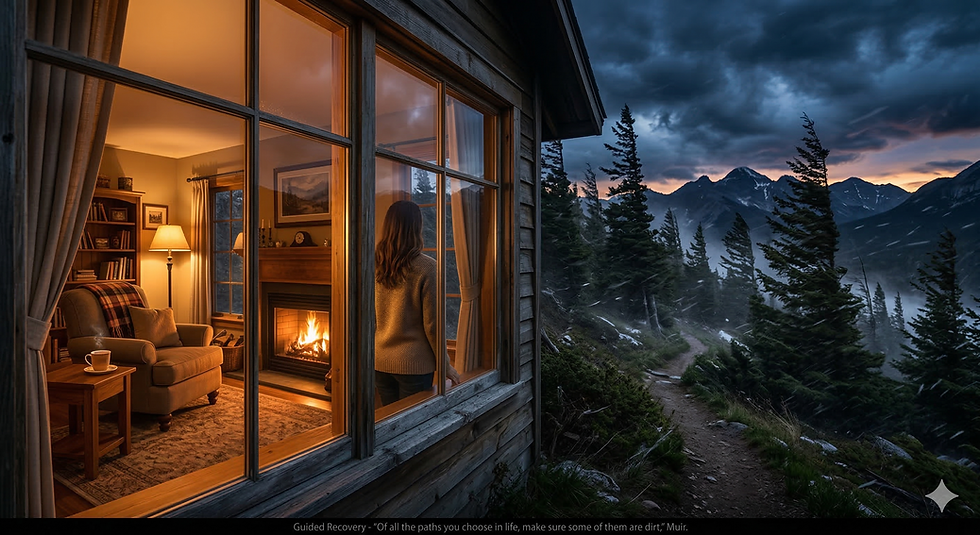
Yesterday was one of those days for me. I did everything "right" by the indoor manual. I put in the miles on my Peloton, I tackled the clutter in my house, I caught up on office work, and I even nourished myself with a pot of homemade soup. I was busy, I was productive, and I was safe.
Yet, by 7 pm, a familiar, unwelcome guest arrived: anxiety.
It felt like an internal "whiteout." Despite a productive day, my nervous system was firing distress signals. When I looked at my Daily 10 checklist, the culprit was staring me in the face. I had retreated from the wind so quickly that I had skipped my time in nature. I had stayed "paved" all day, and my biology was paying the price.
Here is the science of why "Mother Nature" is the ultimate regulator for the recovery journey.
The Science of the "Great Outside"
1. Cortisol Clearance and the Amygdala Reset
When we spend the entire day inside four walls, our perspective physically and mentally shrinks. This can lead to "rumination"—the brain's tendency to loop over stressful thoughts.
The Biology: Research into "Forest Bathing" (Shinrin-yoku) shows that being in nature significantly lowers cortisol (the stress hormone) and heart rate. Nature acts as a physical "sacred pause" for the amygdala.
The Benefit: It moves you from the high-alert "sympathetic" nervous system back into the "parasympathetic" state—where healing and digestion happen.
2. Phytoncides: Nature’s Natural Anxiolytic
It’s not just the view; it’s the air itself. Trees and plants emit antimicrobial allelochemicals called phytoncides to protect themselves from rotting and insects.
The Biology: When we breathe these in, it increases the activity of our "Natural Killer" (NK) cells and lowers the production of stress proteins.
The Benefit: It is quite literally a biological "breath of fresh air" that reduces feelings of hostility and depression.
3. The "Soft Fascination" Effect
Indoor tasks (like Pelotons, emails, and housecleaning) require "directed attention." This is exhausting for the brain and leads to mental fatigue.
The Biology: Nature provides "soft fascination"—clouds moving, leaves rustling, water flowing. This type of stimuli captures our attention without effort.
The Benefit: This allows our "directed attention" muscles to rest and recover. It clears the "digital fog" and restores our ability to focus.
4. Vitamin D and the Serotonin Connection
Even on a "yucky" day, the lux levels of natural light are significantly higher than indoor lighting.
The Biology: Natural light triggers the synthesis of Vitamin D and the release of serotonin, the hormone associated with mood stabilization and feeling calm.
The Benefit: This is the antidote to the "exposed nerve" feeling. It provides the chemical "insulation" we need to handle the bumps on the trail.
The Recovery Lesson: Don't Retreat from the Dirt
Yesterday reminded me that we aren't meant to be "indoor creatures." We are part of the ecosystem. When we isolate ourselves from the wind, the dirt, and the sky, we lose our grounding.
Even if it’s just five minutes of standing in the wind or a brisk walk around the block, getting outside is a non-negotiable part of the recovery gear. It turns out that the "yucky" weather outside is often much better for our souls than the "perfect" stagnant air inside.
The next time you feel that anxiety rising, don't look for a screen or a chore—look for a trail.



Comments